Some examples of Applications to Ecological Issues
Applications to Ecological Issues: Some examples
2. The IFM for amphibian conservation[12]
SIN: http://www.wine-tours.ch/quickdesigner/uploads/winetoursch/bildschirmfoto-2014-03-27-um-11-52-03.png MODIFICATA

Dx: http://www.formen-der-natur.ch/Portals/0/Gallery/Album/28/09%20September%20Fl%C3%A4scherberg.jpg MODIFICATA
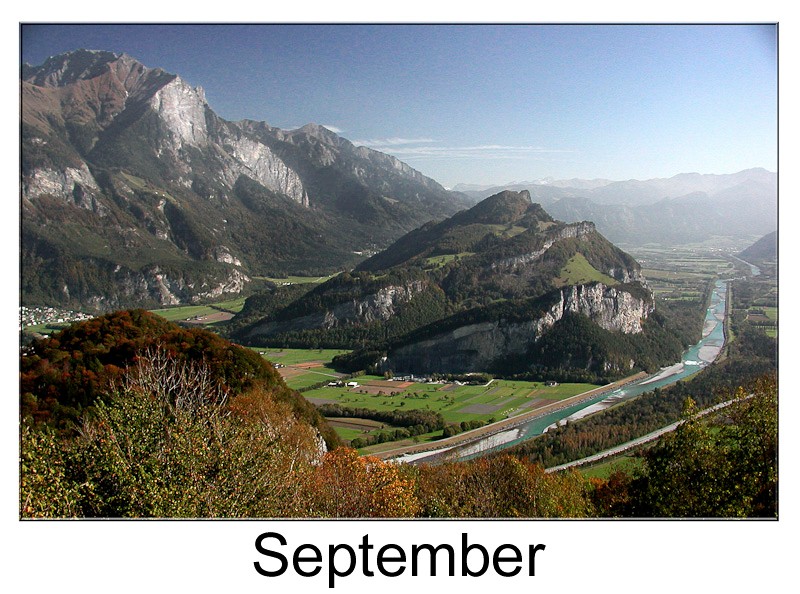
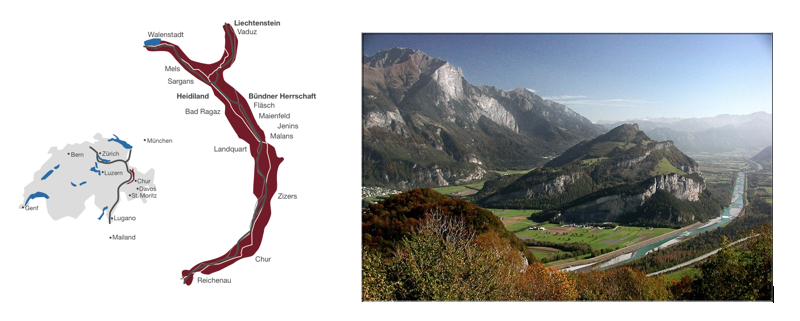
Figure 12.12 - The Bündner Herrschaft region, Switzerland.
The Bündner Herrschaft region (BHR) is located in south-eastern Switzerland. The amphibian conservation area covers c. 20 km2 around the Fläscherberg mountain (Figure 12.1), including residential zones located in the communities of Malans, Jenins, Maienfeld and Fläsch. Ravines cutting through the slopes and crossing the Rhine valley floor limit land use and provide natural breeding sites for amphibians. Additional breeding sites in several residential and industrial areas have been established by owners of family houses and other people or organizations interested in amphibian conservation.
In the BHR, the cantonal Office for Nature and Environment is aware that Hyla arborea (L.) and members of the Rana esculenta (L.) complex were observed only until the second half of the 20th century, when they apparently became extinct. Moreover, the presence of one endangered species (B. bufo) and three species at risk of extinction (T. cristatus, T. vulgaris, B. variegata) represented a valid justification for the design and implementation of an amphibian conservation project in the region.
An important management activity consists of creating new breeding habitats interventions: the cantonal Office for Nature and Environment proposed two groups of new breeding sites, called [A] and [B] and represented in Figure 12.2. Each new patch has a dimension of 200 m2.
Here we limit our attention to Bu. bufo. The metapopulation consists of 40 small patches, 13 of which were considered as occupied after a 5-year monitoring period. In Figure 12.2 the metapopulation has been represented in the usual way, apart from the patch size: as most of the patches are very small, all the patches are represented with the same area for the sake of clearness. The two proposed management actions are represented as well.
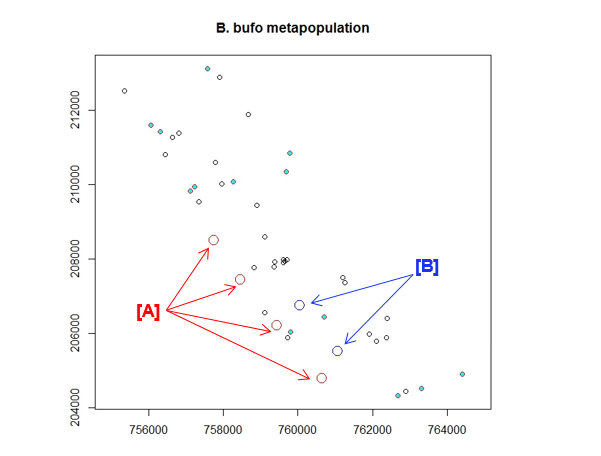
Figure 12.13 – The Bu. bufo metapopulation in Gilioli et al., 2008. The two groups of new breeding sites are also represented by greater circles: group A (red) and group B (blue).
With respect to [A] and [B], two management configurations have been considered: the case of new and empty patches (denoted by [A0] and [B0]) and the case of new and occupied patches (denoted by [A1] and [B1]). In the latter case the patches are assumed to be occupied by a stable population because of either a hypothesized transfer of individuals from occupied sites or a naturally occurring colonization.
The IFM has been applied to find which of these four strategies is optimal in the sense of making the predicted metapopulation dynamics as far as possible from the total extinction. That is, the basic IFM without rescue effect has been fitted to the presence/absence data IFM for each of the four hypothesized management strategies. Then, the fitted incidences (see Eq. 10.3) have been computed and the Kullback-Leibler divergence between the fitted incidences and the reference situation of total extinction have been computed. It can be proved that this distance is given by
$$-\sum_{i=1}^{n} ln(1-\hat{J}_i ) $$where \(\hat{J}\) are the fitted incidences.
The following results have been obtained:
|
Management strategy |
distance from total extinction (K.L. divergence) |
|
[A0] |
40.88 |
|
[A1] |
46.93 |
|
[B0] |
39.73 |
|
[B1] |
43.11 |
indicating that strategy [A1], i.e., the creation of the four new breeding sites denoted by the red color in Figure 12.2, all made occupied in some way, is the one maximally reducing the distance of the metapopulation from the total extinction.
As far as parameter estimation is concerne, parameter \(\alpha\) has been estimated on the basis of expert opinion (\(\alpha\)=0.0014), while parameters x, y and A0 as well, have been estimated by the MLE method. In this model, the distance dij between patches i and j has been multiplied by 4 if the habitat linking the two patches is unfavorable for amphibians moving, due to the presence of the Fläscherberg mountain or of the intersection by the freeway.