Some examples of Applications to Ecological Issues
| Site: | LifeWatch ERIC Training Platform |
| Course: | Spatially explicit metapopulation model - Incidence Function Model |
| Book: | Some examples of Applications to Ecological Issues |
| Printed by: | Guest user |
| Date: | Tuesday, 15 September 2026, 2:27 PM |
Description
Applications to Ecological Issues: Some examples
1. Applications to Ecological Issues: Some examples
In recent years, metapopulation models have been connected to management always more in the ecological literature:
a) Glanville fritillary butterfly, Melitæa cinxia, Hanski and its research group, in several papers
b) European nuthatch, Sitta europea, ter Braak et al., 1998
c) American pika, Ochotona princeps, Moilanen et al., 1998
d) Southern Emu–wren, Stipiturus malachurus intermedius, Westphal et al., 2003
e) Gypsy moth, Lymantria dispar , Bogich & Shea, 2008
f) Common toad, Bufo bufo, Gilioli et al., 2008
g) Malleefowl, Leipoa ocellata, Nicol & Chadès, 2011
h) Acorn weevils, Curculio, Govindan et al., 2012
i) Pine processionary moth, Traumatocampa pityocampa, Gilioli et al., 2013.
This short list, very far to be complete, contains papers where metapopulations models, like the IFM in a), b) and c), are mainly used to gain insight about the metapopulation dynamics at the timescale at which managers operate. This is the main exploitation of (spatially explicit) metapopulation models. A less explored use is for management strategies evaluation, that is for a quantitative evaluation of the expected consequences of different management practices. This kind of evaluation is very important, as the outcomes of conservation management actions are not always as expected. Models are key components on management programs, as they provide a means of predicting outcomes of alternative management actions (Nichols, 2012). Metapopulation models should be embedded in a decision-making framework to give managers the capability of ranking alternative decisions (Westphal et al., 2003). This means that a decision problem should be clearly stated, by defining
|
This means that the objectives of the management should be explicitly and clearly stated in terms of metapopulation model variables (Possingham et al., 2001; Gilioli et al., 2013).
This has been done, for instance, by applying stochastic dynamic programming, like in d), e) and g). However, stochastic dynamic programming is computationally complex and its applicability limited to small metapopulations (Nicol and Chadès, 2011).
In f) and i) a different approach has been developed, to evaluate a finite number of metapopulation management strategies. It aims at evaluating the extent to which each strategy makes the metapopulation dynamics either close to or far from some situation of reference:
|
CONSERVATION: |
far from |
TOTAL EXTINCTION |
|
PEST CONTROL: |
close to |
TOTAL EXTINCTION |
The use of stochastic metapopulation models allows the comparison of probability distributions of future observations under the effect of each strategy, provided that strategies are expressed in terms of the model elements, as in Figure 1.8. In f) and i), that probability distributions come from an Incidence Function Model.
The distance between the predicted metapopulations dynamics and the reference situation of total extinction is measured by the Kullback-Leibler divergence, also known as Kullback-Leibler information measure (Kullback and Leibler, 1951; see also Dacunha-Castelle and Duflo, 1986).
In the following sections the results obtained in f) for amphibian conservation and in i) for pest control will be summarized, by omitting any further mathematics.
2. The IFM for amphibian conservation[12]
SIN: http://www.wine-tours.ch/quickdesigner/uploads/winetoursch/bildschirmfoto-2014-03-27-um-11-52-03.png MODIFICATA

Dx: http://www.formen-der-natur.ch/Portals/0/Gallery/Album/28/09%20September%20Fl%C3%A4scherberg.jpg MODIFICATA
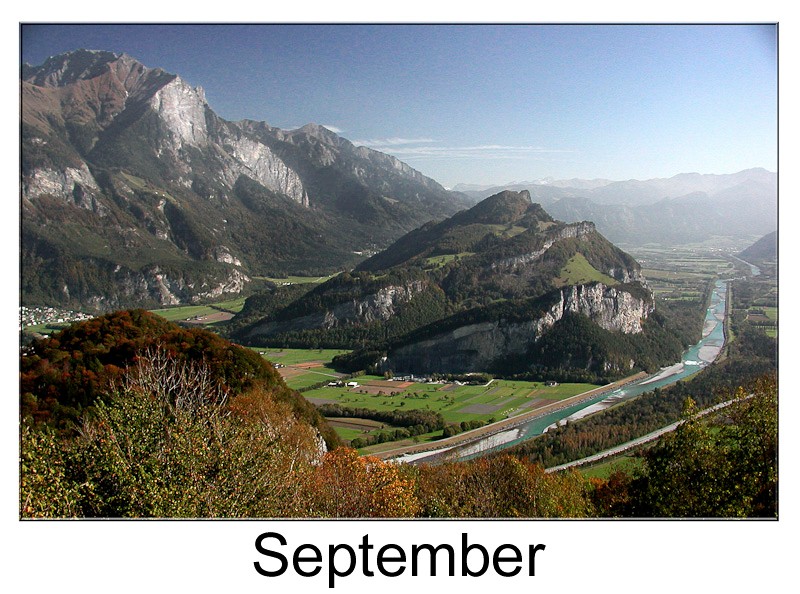
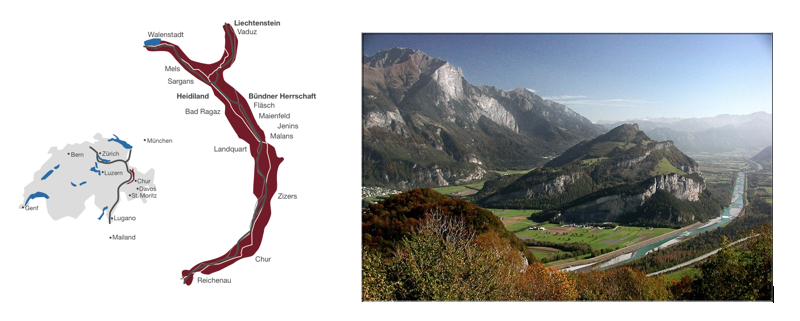
Figure 12.12 - The Bündner Herrschaft region, Switzerland.
The Bündner Herrschaft region (BHR) is located in south-eastern Switzerland. The amphibian conservation area covers c. 20 km2 around the Fläscherberg mountain (Figure 12.1), including residential zones located in the communities of Malans, Jenins, Maienfeld and Fläsch. Ravines cutting through the slopes and crossing the Rhine valley floor limit land use and provide natural breeding sites for amphibians. Additional breeding sites in several residential and industrial areas have been established by owners of family houses and other people or organizations interested in amphibian conservation.
In the BHR, the cantonal Office for Nature and Environment is aware that Hyla arborea (L.) and members of the Rana esculenta (L.) complex were observed only until the second half of the 20th century, when they apparently became extinct. Moreover, the presence of one endangered species (B. bufo) and three species at risk of extinction (T. cristatus, T. vulgaris, B. variegata) represented a valid justification for the design and implementation of an amphibian conservation project in the region.
An important management activity consists of creating new breeding habitats interventions: the cantonal Office for Nature and Environment proposed two groups of new breeding sites, called [A] and [B] and represented in Figure 12.2. Each new patch has a dimension of 200 m2.
Here we limit our attention to Bu. bufo. The metapopulation consists of 40 small patches, 13 of which were considered as occupied after a 5-year monitoring period. In Figure 12.2 the metapopulation has been represented in the usual way, apart from the patch size: as most of the patches are very small, all the patches are represented with the same area for the sake of clearness. The two proposed management actions are represented as well.
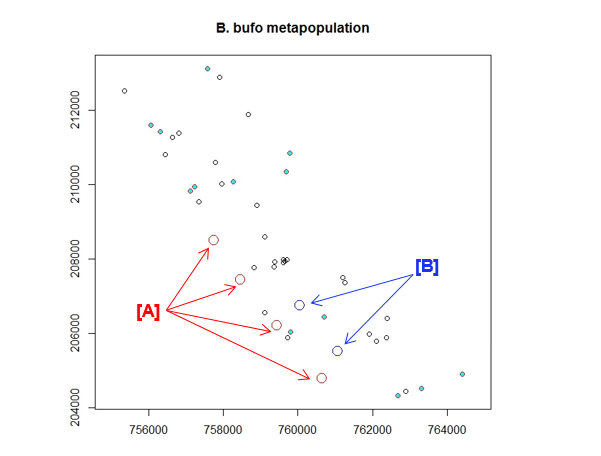
Figure 12.13 – The Bu. bufo metapopulation in Gilioli et al., 2008. The two groups of new breeding sites are also represented by greater circles: group A (red) and group B (blue).
With respect to [A] and [B], two management configurations have been considered: the case of new and empty patches (denoted by [A0] and [B0]) and the case of new and occupied patches (denoted by [A1] and [B1]). In the latter case the patches are assumed to be occupied by a stable population because of either a hypothesized transfer of individuals from occupied sites or a naturally occurring colonization.
The IFM has been applied to find which of these four strategies is optimal in the sense of making the predicted metapopulation dynamics as far as possible from the total extinction. That is, the basic IFM without rescue effect has been fitted to the presence/absence data IFM for each of the four hypothesized management strategies. Then, the fitted incidences (see Eq. 10.3) have been computed and the Kullback-Leibler divergence between the fitted incidences and the reference situation of total extinction have been computed. It can be proved that this distance is given by
$$-\sum_{i=1}^{n} ln(1-\hat{J}_i ) $$where \(\hat{J}\) are the fitted incidences.
The following results have been obtained:
|
Management strategy |
distance from total extinction (K.L. divergence) |
|
[A0] |
40.88 |
|
[A1] |
46.93 |
|
[B0] |
39.73 |
|
[B1] |
43.11 |
indicating that strategy [A1], i.e., the creation of the four new breeding sites denoted by the red color in Figure 12.2, all made occupied in some way, is the one maximally reducing the distance of the metapopulation from the total extinction.
As far as parameter estimation is concerne, parameter \(\alpha\) has been estimated on the basis of expert opinion (\(\alpha\)=0.0014), while parameters x, y and A0 as well, have been estimated by the MLE method. In this model, the distance dij between patches i and j has been multiplied by 4 if the habitat linking the two patches is unfavorable for amphibians moving, due to the presence of the Fläscherberg mountain or of the intersection by the freeway.
3. The IFM for area-wide pest management[13]
In Gilioli et al., (2013) a mosaic of different spatial units (patches) infested by a monophagous pest has been considered and the interplay between pest population dynamics, dispersal and area-wide control strategies investigated. A threshold-based management is assumed to be an appropriate control strategy. Therefore, the transition of population abundance from above to below the management threshold, due to either the decline of the local population or to control intervention, is represented as an extinction process. This allows the application of an IFM.
Data from a three years survey of the Pine processionary moth (Traumatocampa pityocampa (Den. and Schiff)) populations dynamics in fragmented forest stands of the National Park of Aspromonte, Calabria, Italy (Figure 12.3) have been analysed.
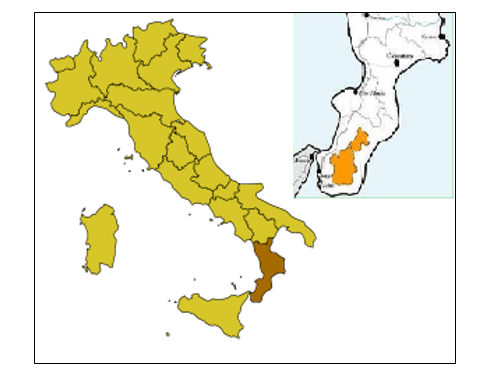
Figure 12.14 – Calabria region in Italy and National Park of Aspromonte in Calabria.
Italia: 
Dettaglio: http://www.corpoforestale.it/flex/images/D.b69b2522d0cd945a94aa/P_N_ASPROMONTE_250.JPG
The metapopulation consists of 32 forest fragments, see Figure 12.4.
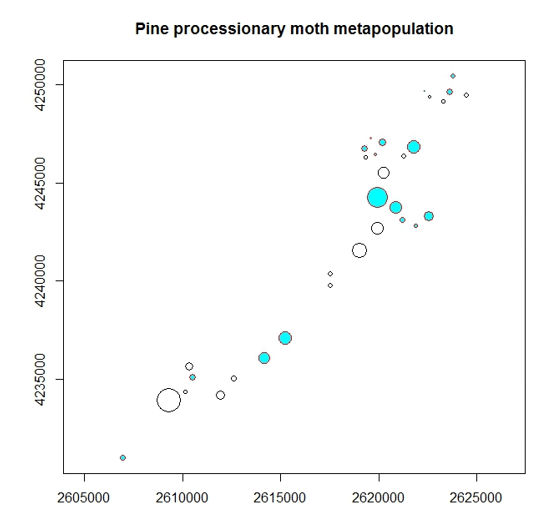
Figure 12.15 – Pine processionary moth metapopulation in Gilioli et al., 2013: first presence/absence vector.
In this study, different management strategies of pest control are defined in terms of spatial and temporal allocation of treatments, regardless of the adopted control technique. The only requirements are that the patch area is the minimum spatial unit of intervention, and control operations target the entire pest populations in a patch. A threshold-based pest management has been considered, meaning that local population abundance is kept under a threshold whatever defined (e.g., action threshold) as a consequence of an effective intervention.
For the spatial allocation, three kinds of strategies are compareda) scattered sites, (b) close sites and, due to the geometry of the PPM metapopulation, (c) in line sites. Examples are in Figure 12.5.
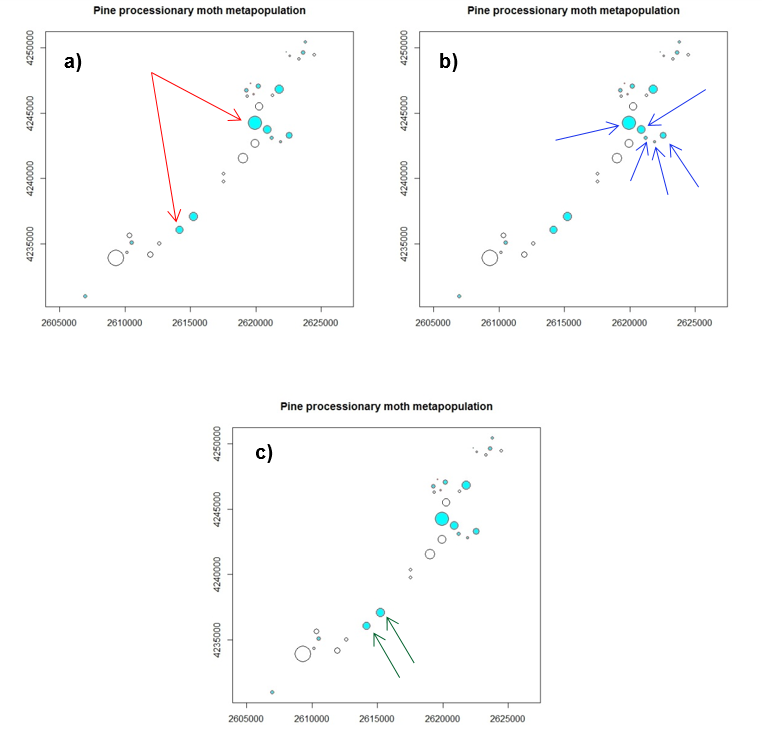
Figure 12.16 – Instances of scattered (a), close (b) and in line (c) patches to be treated (marked by arrows), representing three possible spatial treatment allocations.
In this paper, a time-dependent IFM (without rescue effect) has been fitted to all the considered spatial management strategies. Moreover, the inclusion of time allowed the consideration of different combinations in time of spatial strategies. That is, a short-term horizon has been established (five years after the last collection of data), at each time in-between some strategy has been applied, and the effect of each sequence of treatments has been evaluated at the last year by the Kullback-Leibler divergence. This required the repeated simulation of the metapopulation dynamics for 5 years after the last collection of data, as in Example 7.3 to estimate P(XT = 0) at the evaluation time T (i.e., 5 years after the last collection of data), where XT is the random vector of presence/absence at time T, as in Section 6.1.. At time T, the distance of the predicted metapopulation status from total extinction according to the Kullback-Leibler divergence is
$$-ln[P(X_(T,1)=0,…,X_(T,n)=0 )]$$The best strategy is the one providing the lowest value of such a distance.
After the examination of several management strategies, the authors argue that treating close patches has an higher effect that treating scattered patches, as this seems reduce connectivity. About this issue, however, further deepen insight should be gained yet.
4. References
Bogich T., Shea K. (2008) - A state-dependent model for the optimal management of an invasive metapopulation. Ecological Applications 18, 748–761.
Dacunha-Castelle D., Duflo M. (1986) - Probability and statistics I. New York: Springer.
Gilioli G., Bodini A., Baumgaertner J., Weidmann P., Hartmann J. (2008) - A novel approach based on Information Theory to rank conservation strategies: an application to amphibian metapopulations (with discussion). Animal Conservation, 11, 453-462.
Gilioli G., Bodini A., Baumgaertner J. (2013) - Metapopulation modelling and area-wide pest management strategies evaluation. An application to Pine processionary moth. Ecological Modelling, 260, 1-10.
Govindan B.N., Kéry M., Swihart R.K. (2012) - Host selection and responses to forest fragmentation in acorn
weevils: inferences from dynamic occupancy models. Oikos, 121, 623–633.
Hanski I. (1998) - Metapopulation dynamics. Nature,396, 41–49.
Hanski I., Kuussaari M., Nieminen M. (1994) - Metapopulation structure and migration in the butterfly Melitaea cinxia. Ecology, 75,747–762.
Kullback S., Leibler R.A. (1951) - On information and sufficiency. Annals of Mathematical Statistics, 22, 79–86.
Moilanen A., Smith A.T., Hanski I. (1998) - Long-term dynamics in a metapopulation of the American pika. The American Naturalist,152, 530-542.
Nichols J.D. (2012) - Evidence, models, conservation programs and limits to management. Animal Conservation, 15, 331-333
Nicol S., Chadès I. (2011) - Beyond stochastic dynamic programming: a heuristic sampling method for optimizing conservation decisions in very large state spaces. Methods in Ecology and Evolution, 2, 221–228.
Possingham H.P., Andelman S.J., Noon B.R., Trombulak S., Pulliam H.R. (2001) - Making smart conservation decisions. In: Soule M.E. & Orians G.H. (Eds.), Conservation Biology: Research Priorities for the Next Decade. Pulliam Press, Washington, USA, 225–244.
ter Braak C.J.F., Hanski I., Verboom J. (1998) - The incidence function approach to modeling of metapopulation dynamics. In: Bascompte, J. & Solé, R.V.(eds.). Modeling spatiotemporal dynamics in ecology. pp 167-188. Springer, New York.
Westphal M.I., Pickett M., Getz W.M., Possingham H.P. (2003) - The use of stochastic dynamic programming in optimal landscape reconstruction for metapopulations. Ecological Applications, 13, 543-555.