A few hints about the ecological problem and the Incidence Function Model (IMF)
A few hints about the ecological problem and the Incidence Function Model
A few hints about the ecological problem and the Incidence Function Model (IFM) - Page 5/6
The colonization probability of any patch depends on the contribution from all the other occupied patches. In Figure 7, all the patches occupied at time t contribute to the colonization of patch A at the following time, t+1, as indicated by the red arrows. Each contribution depends on both the patch area (the larger the area, the higher the contribution) and the distance from patch A (the longer the distance, the lower the contribution). That is, the colonization probability depends on the connectivity of the patch.
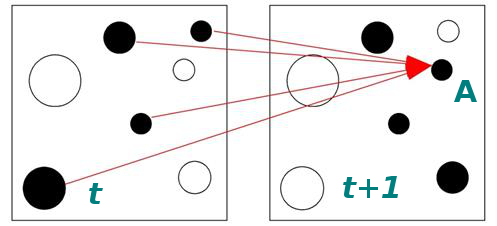
Figure 7 - At time t +1, any empty patch could become occupied by colonization. All the occupied patches give a contribution to the colonization of patch A, according to both their area and distance from A.
In other words, in the IFM the patch area is assumed as a proxy for the population size, while the intra-patches distance takes into account the survival rate of migrant over the distance.