A few hints about the ecological problem and the Incidence Function Model (IFM) - Page 1/6
The concept of habitat fragmentation has been deeply discussed, for instance, in Franklin et al. (2002) and in Didham (2010).
In fragmented landscapes, populations are often structured as a
metapopulation (Melbourne et al., 2004), that is as a
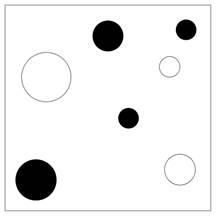
set of local populations within some larger area, where typically migration from one local population to at least some other patches is possible (Hanski and Simberloff, 1997). Figure 2 represents by a diagram a small metapopulation with four occupied patches (the black disks) and three empty patches (the circles).
| Figure 2 - Diagram of a small metapopulation. Black disks: occupied patches; circles: empty patches. Migrations from occupied to empty patches are possible. |
Metapopulation models were originally proposed for pests and were based on a simple description of the frequency of occupied patches (Levins, 1969; Ives and Settle, 1997).
 |
|
|
p : proportion of occupied sites |
| dp/dt = mp(1-p) – ep |
|
e : extinction rate |
|
|
m : colonization rate |
|
| Figure 3 – Prof. Richard Levins and the Levins model. |
In the Levins model (Figure 3) it is assumed that all the habitat patches are similar, so that according to this model, a diagram of the spatial structure of a metapopulation should be as in Figure 4, where all the patches are represented by equal and contiguous squares, so that the spatial information disappears.
| Figure 4 – Metapopulation spatial structure for Levins-type models: patches are represented by equal and contiguous squares.
|