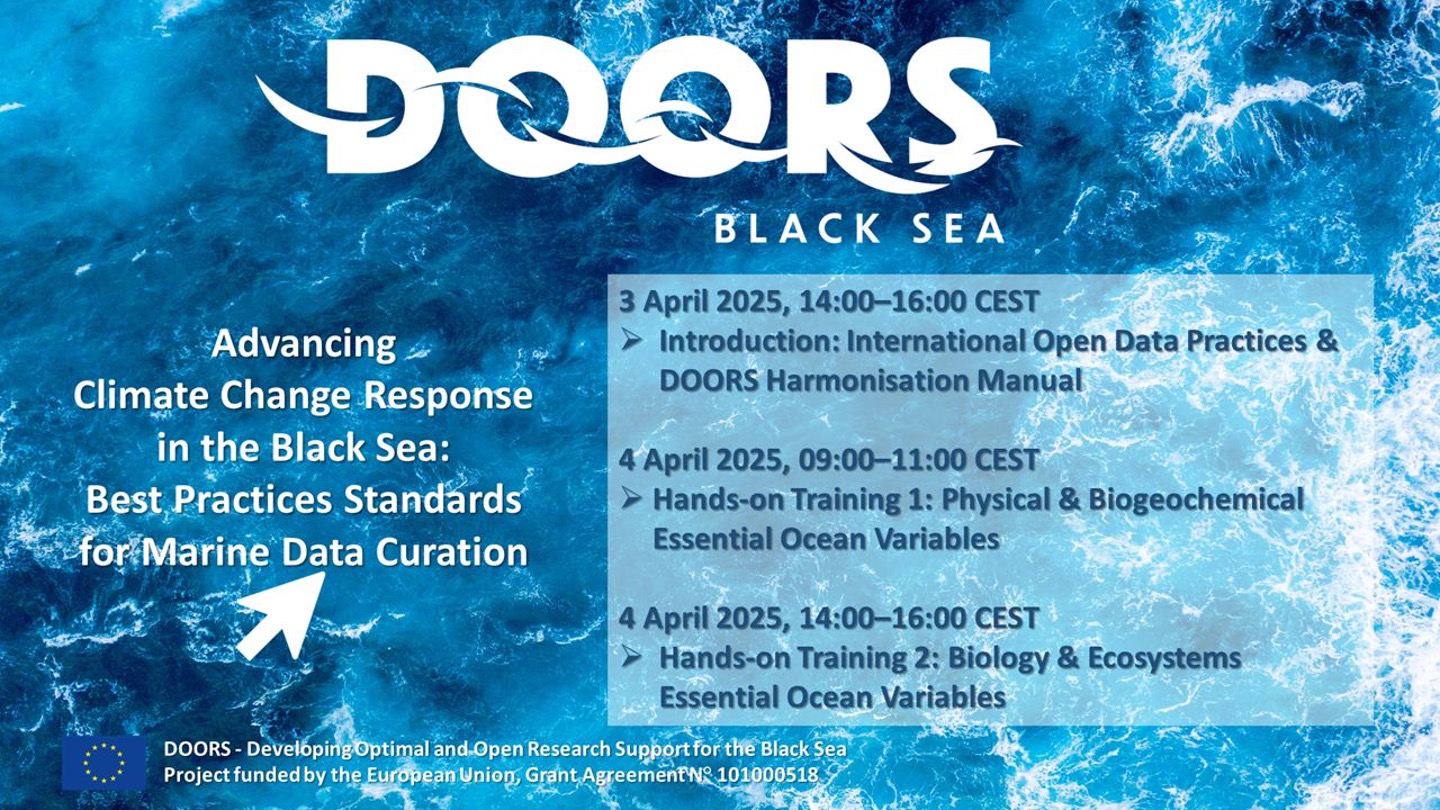
Advancing Climate Change Response in the Black Sea: Best Practices & Standards for Marine Data Curation
Section outline
-
As climate change accelerates, the demand for accurate, high-quality marine data is more critical than ever. The Black Sea, a region particularly vulnerable to environmental shifts, requires harmonised data collection, curation, and dissemination following international standards. Ensuring access to reliable data enables scientists, policymakers, and environmental managers to develop informed strategies for mitigating and adapting to climate impacts. The DOORS project, in collaboration with leading European Marine Research Infrastructures and the European Global Ocean Observing System (EuroGOOS), is addressing this need by promoting best practices in marine data curation for the Black Sea.
This webinar and training will introduce participants to international data standards and the DOORS data harmonisation manual, followed by hands-on sessions on curating data related to GOOS Essential Ocean Variables. Participants will hear from European Marine Research Infrastructures and international experts about tools and approaches to enhance data quality, accessibility, and interoperability, while aligning with FAIR principles. This event is designed for Black Sea scientists and data managers, as well as all those interested in international marine data management.
-
This session will focus on the importance of standardised marine data management, with insights from experts across DOORS, EMODnet, EuroGOOS Working Group on Data Management, Exchange, and Quality1 (DataMEQ), and European Marine Research Infrastructures. The DOORS data harmonisation manual will be presented as a key tool for fostering uniformity in data collection and curation in the Black Sea.
After the presentations, a discussion session of the webinar will address the Black Sea data challenges, where participants will have the opportunity to share experiences and explore potential solutions to address regional data gaps.
1EuroGOOS Data Policy 2023 - European implementation of UNESCO-IOC Data Policy and Terms of Use 2023: https://repository.oceanbestpractices.org/handle/11329/2438
Agenda:
- International marine data initiatives and regional partnerships - Thierry Carval, Ifremer, France / EuroGOOS DataMEQ WG Chair
- OPEN and FAIR Data, an EMODnet Perspective - Conor Delaney, European Marine Observation and Data Network (EMODnet) / EDITO Infra
- DOORS System of Systems, Opportunities and next steps - Violeta Slabakoba, IO-BAS, Bulgaria
- DOORS Harmonisation Manual - Popi Pagkou, HCMR, Greece
- Interactive panel discussion with European Research Infrastructures: Aljaz Maslo (EMSO ERIC), Yann-Hervé De Roeck (Euro-Argo ERIC), Christina Pavloudi (EMBRC), Alberto Basset (LifeWatch ERIC) - moderated by Andrew Tyler (University of Stirling, UK)
-
Students mustMark as done
Slides
-
Students mustMark as done
-
Students mustMark as done
-
Students mustMark as done
-
Students mustMark as done
-
Students mustMark as done
-
-
Physical and biogeochemical data curation and use: Participants will learn how to manage and curate data related to physical and biogeochemical Essential Ocean Variables (EOVs). Trainers from Euro-Argo ERIC, EMSO ERIC, and EuroGOOS will guide the session.
- EMSO ERIC - Aljaz Maslo
- Introduction to EOVs for physical and biogeochemical parameters - Thierry Carval, Ifremer, France / EuroGOOS DataMEQ WG Chair
- Euro-Argo - Delphine Dobler
-
Students mustMark as done
Slides
-
Students mustMark as done
-
Students mustMark as done
-
-
Biology and ecosystems data curation: This session will dive into biological and ecosystem data curation, covering best practices for managing marine biodiversity data, with input from EMBRC ERIC and LifeWatch ERIC.
- EMBRC - Christina Pavloudi
- LifeWatch ERIC - Martina Pulieri and Eftychia Tzafesta
-
Students mustMark as done
Slides
-
-
-