Section: 7. Weight file | Biotope - Cumulative IMPacts of invasive ALien species (CIMPAL) version | LifeWatch ERIC Training Platform

Main course page
  • Biotope - Cumulative IMPacts of invasive ALien species (CIMPAL) version

    What this tutorial is about
    This tutorial will guide you during the use of the CIMPAL (Cumulative IMPacts of invasive ALien species) version of the Biotope vulnerability Workflow, which assesses the habitat vulnerability to the introduction and establishment of Invasive Alien Species (IAS) and the cumulative effects of their negative impacts. The tutorial will clarify how to prepare the input data, as well as the step-by-step use of the workflow.

    About the workflow
    You can access the workflow through My Lifewatch Platform at  https://my.lifewatch.eu under LifeWatch ERIC Products/ LifeWatch VREs/ Biotope/  Run a new workflow/ CIMPAL.
    For further information regarding the overall initiative that leaded to the design of the validation cases and the development of the workflows, please consult  the LifeWatch Internal Joint Initiative dedicated platform: https://www.lifewatch.eu/internal-joint-initiative/workflows/.

    Get in touch with the scientific team

    Heliana TeixeiraHeliana Teixeira, CESAM Centre for Environmental and Marine Studies, Biology Department, University of Aveiro


    Julien RadouxJulien Radoux, UCLouvain 


7. Weight file

  • 7. Weight file

    The weight file is the key of the CIMPAL analysis. This matrix (provided as a csv file) assigns a value of impact for each taxon inside each biotope. It links a species impact to a given biotope using predefined weights (defined by the user’s choice of impact assessment framework 1 ). A species can impact multiple biotope categories with different impact weights. If available, the strength of evidence 2 of each specific species-biotope impact weight can be accounted for, which will allow to calculate an "uncertainty averse” 2 version of the CIMPAL index, otherwise a "precautionary" version is calculated.

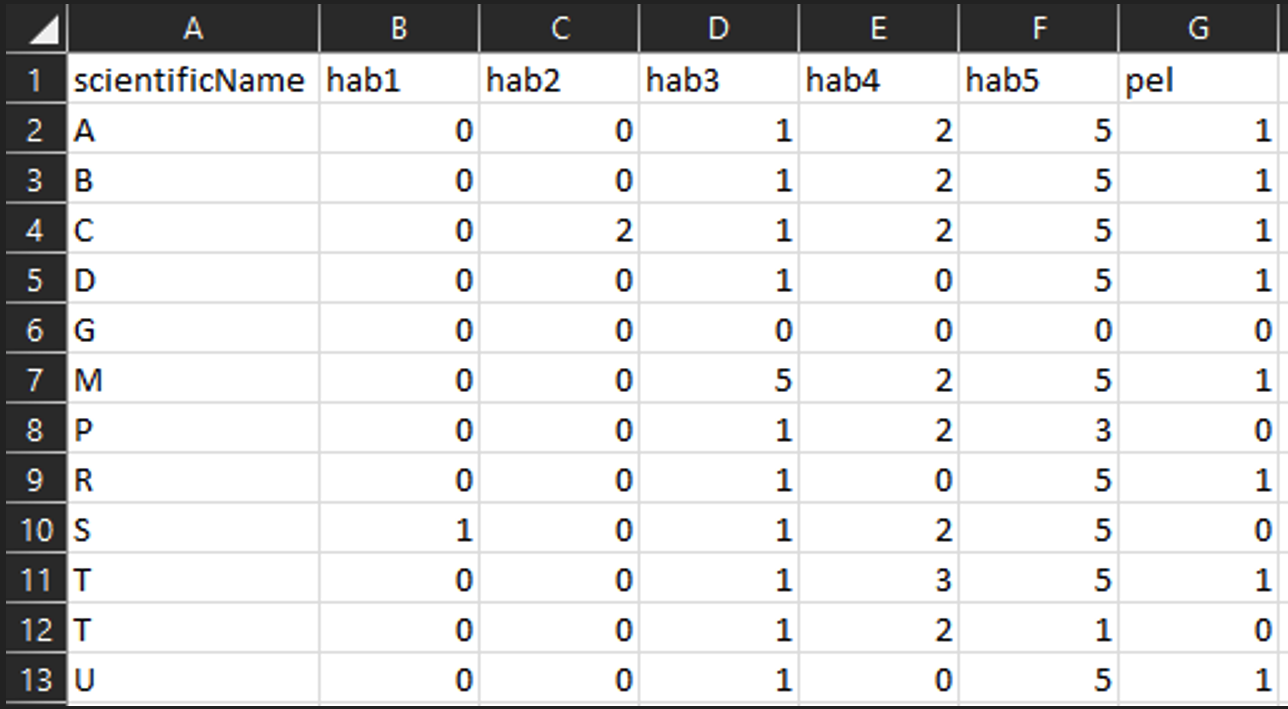
    The input must be a file with .csv extension (with TSV) in a matrix format (e.g., Fig. 9) with the first column listing the alien species names scientificName and the subsequent n columns’ headers (first row) being the n habitat names <habitatname>. These names must correspond to the names of each spatial layer uploaded in the next step (7 – Biotopes) and must be written in lower case. The cells in the matrix correspond to the value of the Magnitude of Impact (MoI):

    • (column 1) scientificName (text): the scientific name of the alien species must match the names in the input file used in Alien Taxonomy Dataset Uploader (field scientificName)
    • (row 1, column 2 to n+1) <habitatname> (text): the habitat names (lower case) must match spatial layers habitat names in input files Biotopes.zip (<habitatname>)
    • (matrix cells) (integer): score of the Magnitude of Impact (MoI) of each species in each habitat, according to the scoring protocol adopted by the user (more info in e.g., Katsanevakis et al. 2016 1).

    To upload the .csv file with your matrix, press the three vertical dots at the end of the first line on the expanded file list, and choose ‘Upload file’ (e.g., Fig. 7). After the upload is complete, you must select the file before advancing to the next step. Dummy testing data is also available (weight_wp.csv, shown in Fig. 9).

    dummy weight

    Fig. 9 Structure of a weight_wp.csv dummy file, as general example on how to present the CIMPAL weights for each species.

    Note: Please run several workflows if you need different weights for the same taxa; to calculate different versions of the CIMPAL, the workflow needs to be re-run with a new weight matrix.