Synospecies is created and maintained by FactsMission, powered by Franz Inc. AllegroGraph, and uses taxonomic treatment data provided by Plazi.
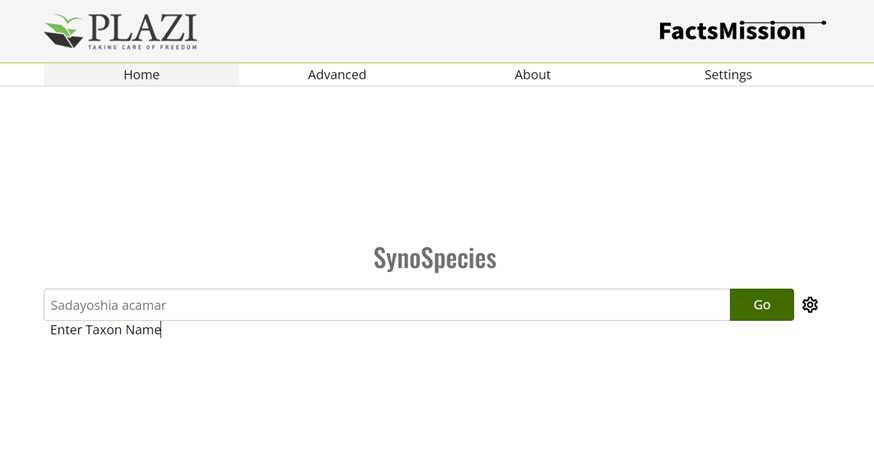
Synospecies allows manually writing and submitting queries in an advanced mode, or sending queries automatically in the background through a simplified interface.
Key Features
- Data Handling: Stores RDF treatment data in an AllegroGraph triple store for efficient storage and structured retrieval of large-scale scientific information.
- SPARQL Queries: Enables execution of SPARQL queries for complex searches across Plazi taxonomic datasets.
- Flexible Interface: Offers advanced mode for custom SPARQL querying and an intuitive interface for automated queries without requiring SPARQL expertise.
As an open-source browser application, Synospecies source code is available on GitHub.
Funded by the European Union’s Horizon 2020 program (grant agreement 101007492) and the Arcadia Fund.
Practical Scenario: Studying Pollinator-Plant Interactions
Context: A researcher is studying interactions between specific pollinators (e.g., the European honey bee, Apis mellifera) and flowering plant species.
Objective: Gather taxonomic treatments of Apis mellifera and its recorded plant interactions from published literature.
Steps for Using Synospecies
- Accessing Synospecies: Navigate to the Synospecies interface and familiarize yourself with the layout.
- Setting Up Your Query: Select Advanced Mode to write SPARQL queries targeting Apis mellifera in the context of pollination, floral visitation, or plant symbiosis.
- Executing the Query: Run the query and evaluate the returned taxonomic treatment results.
- Analyzing Data: Extract plant species interactions and compile the information into a structured format.
- Cross-Referencing: Validate plant species details with external databases like GBIF or EOL for distribution and conservation status.
- Synthesizing Findings: Interpret ecological dynamics and environmental implications based on aggregated data.
- Reporting: Document findings and methodology in a research paper or conference presentation.
Key Benefits
- Comprehensive Access: Direct access to structured taxonomic treatment records.
- Targeted Search: Ability to write custom SPARQL queries tailored to precise biological interactions.
- Efficiency: Streamlines scientific literature aggregation, saving manual research time.