Introduction to BKH
Section outline
-
Description
This course presents an introduction to the BKH. It presents the structure of the BKH, the FAIR Data Place section, and its key role in the openness of the data.
Target Audience
- Academic researchers
- Graduate students
- Journal editors and reviewers
- Scientific writers
Objectives
By the end of this course, participants will be able to:
- Understand the features and benefits of the BKH.
- Navigate the BKH platform confidently.
- Understand the transfer mechanisms and the workflow of biodiversity data.
Contents
- Introduction and Training Materials
- Structure of the BKH
- The FAIR Data Place
- Guidelines and Protocols
- Relevant Projects
-
Semantic web technologies are a set of standards and protocols designed to enhance the way data and information are represented, linked, and processed on the World Wide Web. These technologies aim to add semantics, or meaning, to web content, making it easier for machines (computers) to understand and interpret the information. The core technologies and principles that underpin the semantic web include RDF (Resource Description Framework), OWL (Web Ontology Language), and SPARQL (SPARQL Protocol and RDF Query Language). Here's how they work together:
-
RDF (Resource Description Framework):
- RDF is a foundational technology in the semantic web. It provides a simple, flexible, and standardized way to represent data and its relationships.
- RDF uses triples to represent data. A triple consists of a subject, a predicate (or property), and an object, forming a statement like "subject-predicate-object."
- Subjects and objects in RDF triples can be resources (e.g., URLs or identifiers) or literal values (e.g., text or numbers).
- Predicates define the relationships between subjects and objects and often refer to standardized vocabularies (ontologies) to ensure consistency and shared understanding of the data.
-
Ontologies:
- Ontologies are formal vocabularies or taxonomies that define the terms and concepts used in a particular domain. They provide a shared understanding of the meaning of data.
- OWL (Web Ontology Language) is a widely used language for creating ontologies. It allows for rich and expressive modeling of concepts, relationships, and constraints.
For example, Gene Ontology is a widely used ontology in molecular biology. It describes the functions and attributes of genes and gene products, classifying them as "biological process," "molecular function," and "cellular component."
-
Triples and Linked Data:
- Data represented in RDF triples can be linked to other data sources. This is one of the key features of the semantic web.
- Through the use of unique identifiers and standard predicates, different datasets can link to common concepts and resources, enabling data integration and enrichment.
-
SPARQL:
- SPARQL is a query language for RDF data. It allows users to query, retrieve, and manipulate data represented in RDF format.
- SPARQL queries can search for specific patterns within the RDF graph, filter results, and retrieve structured data. It enables data consumers to extract relevant information from linked datasets.
-
Semantics and Inference:
- Semantic web technologies enable machines to infer new knowledge based on existing data and ontologies. This inference process helps derive implicit information from explicit data.
- Ontologies and reasoning engines can be used to perform automated reasoning and make logical deductions from the available data.
-
Data Integration and Interoperability:
- By adhering to RDF and ontologies, different datasets and sources can be integrated more effectively. This improves data interoperability and facilitates data sharing and reuse.
In summary, semantic web technologies provide a structured and standardized way to represent, link, and query data on the web. This semantic layer allows for better machine understanding of data, enabling more intelligent search, data integration, and knowledge discovery. The goal is to make information on the web more accessible and meaningful for both humans and machines.
-
RDF (Resource Description Framework):
-
-
Meeus S, Addink W, Agosti D, Arvanitidis C, Balech B, Dillen M, Dimitrova M, González-Aranda JM, Holetschek J, Islam S, Jeppesen TS, Mietchen D, Nicolson N, Penev L, Robertson T, Ruch P, Trekels M, Groom Q (2022) Recommendations for interoperability among infrastructures. Research Ideas and Outcomes 8: e96180. https://doi.org/10.3897/rio.8.e96180
-
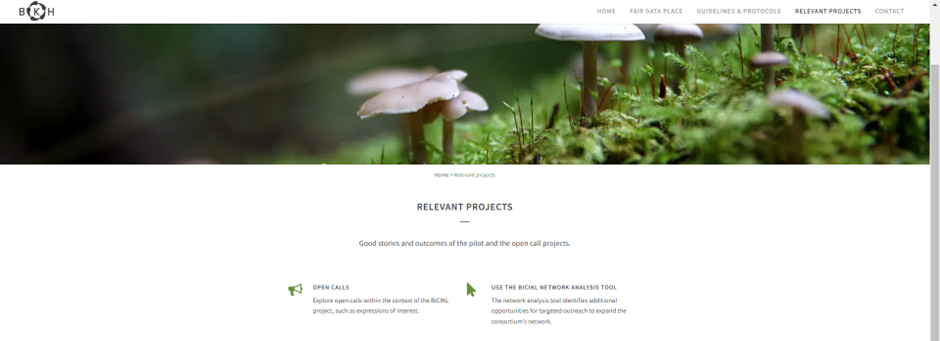
The next component of BKH presents the Open Calls published by the BICIKL project. It provides guidelines and examples of good practice to help proposers to design and submit succesful proposals. Research projects that use linked FAIR biodiversity data are also presented. The page also displays a network analysis tool based on FAIRsharing.org data.