



Welcome to the LifeWatch ERIC
Training Platform!
Lifewatch ERIC Training Platform
LifeWatch promotes training, learning and education for research infrastructure users, researchers, school students and citizens in general, developing bioinformatics skills and engaging citizens in biodiversity and ecosystem research. The LifeWatch ERIC training platform offers targeted content for a wide range of users. Hover over the icons above to read a brief description of what you can find in each category.
Search for a resource


Previous
Next
News and Initiatives
BioDT Webinar: Towards FAIR Digital Twins – First session
The Biodiversity Digital Twin (BioDT) consortium is organising a series of online webinars to stimulate conversations around FAIR with a focus on BioDT and the digital twinning paradigm. Experts and practitioners that deal with different aspects of FAIR implementation and digital twins are invited to join to bring forward discussions that help understand FAIR implementation in a more actionable way. The first webinar session is taking place on Thursday 26 January at 14:00 (CET) and provides a conceptual overview of FAIR principles applicable on digital twinning. Do not hesitate to learn more about this fascinating topic by registering for free! Agenda 14:00 – 14:05: Welcome and introduction 14:05...
BioDT Webinar: Towards FAIR Digital Twins – Second session
The Biodiversity Digital Twin (BioDT) consortium is organising a series of online webinars to stimulate conversations around FAIR with a focus on BioDT and the digital twinning paradigm. Experts and practitioners that deal with different aspects of FAIR implementation and digital twins are invited to join to bring forward discussions that help understand FAIR implementation in a more actionable way. The second webinar session is taking place on Monday 13 February at 16:00 (CET) and provides an overview of FAIR tools applicable to digital twinning. Do not hesitate to learn more about this fascinating topic by registering for free! Agenda 16:00 – 16:05:...
ENVRI Week 2023 – Training session
ENVRI week is the annual consortium meeting of the ENVRI-FAIR project, a week dedicated to Environmental Research Infrastructures. After two years of online meetings, the ENVRI week will be held as a face-to-face meeting in Leipzig, Germany, from 30 January to 3 February 2023. The ENVRI week hosts ENVRI-FAIR project-related sessions and several sessions of the Board of European Environmental Research Infrastructures (BEERi) and the ENVRI Community, including an interactive training session provided by LifeWatch ERIC. Interactive training session: Requirements Elicitation Wednesday February 1, 2023, 11:00 -12:30 CET The FAIR Service LifeCycle starts with the foundational phase of Requirements Elicitation....
Workshop: Essential Biodiversity Variable workflows
Sign up now for the virtual EuropaBon workshop on Essential Biodiversity Variable workflows, run by LifeWatch ERIC (VLIC) Scientific Coordinator and IBED – UvA researcher, Daniel Kissling! The workshop will be held over the course of three days, with sessions lasting for two hours around midday each day. Day 1 will begin with a brief introduction to EBV workflows, followed by break-out sessions to explore and describe workflows for specific EBVs (with aspects of data collection, data integration, modeling). We will focus on the EBV list that has been identified by EuropaBON. On Day 2, we will continue describing the...
EOSC Future Online Workshop: Producing effective service usage instructions and tutorials
Clear and comprehensive documentation is absolutely essential for a service to be discoverable and successfully used – both by existing and potential new target groups. There are many components of service documentation, including promotional materials, descriptions for discovery & catalogues, usage instructions and tutorials, technical specifications and richly commented code. Register now for an interactive session on how to produce effective service usage instructions and tutorials! In this event, we will be diving into the following topics: Different types of online tutorials Planning and design Selecting learning activities including assessment Writing style and practical tips for content creation Tools for...
Webinar: Advancing biodiversity research with the BioDT framework
On 8 June 2023 at 10:30 (CEST) the Biodiversity Digital Twin – BioDT project team will be hosting a one-hour webinar to provide an in-depth technical overview of the development process for the biodiversity digital twin prototype. During the webinar, they will showcase: the key components utilised in constructing the digital twin prototype; the seamless integration of Research Infrastructure data into the digital twin prototype; the interaction between the project and High-Performance Computing, including the utilisation of the LUMI Supercomputer. Register for the webinar!
The LifeWatch ERIC Intensive School: Boost your research with semantic artifacts
In recent years, one of the major challenges in Environmental and Earth Sciences has been managing and searching larger volumes of data, collected across multiple disciplines. Many different standards, approaches, and tools have been developed to support the Data Lifecycle from Data Acquisition to Data Curation, Data Publishing, Data Processing and Data Use. In particular, modern semantic technologies provide a promising way to properly describe and interrelate different data sources in ways that reduce barriers to data discovery, integration, and exchange among biodiversity and ecosystem resources and researchers. This course is built as a five-day intensive school providing the knowledge...
Service documentation for EOSC providers Workshop: describing your service for onboarding
Clear and comprehensive documentation is absolutely essential for a service – or any resource – to be discoverable and successfully used, both by existing and potential new target groups. There are many components of service documentation, including service catalogue entries, promotional materials, usage instructions and tutorials, technical specifications and richly commented code. As an example of the first of these, a brief description (answering the questions What? For whom? and Why use?) is a required metadata item to be provided during the onboarding of all resources into the EOSC Marketplace. In this workshop, we will start by giving an overview...
EOSC providers Workshop: Creating effective usage instructions & tutorials for your services
In order for a service – or any resource – to be successfully and correctly used, clear and comprehensive usage instructions are absolutely essential. While those familiar with your organisation may only need a brief introduction to (new) features, potential new users will require much more detail – for example descriptions of how to interact with interfaces for both humans and machines, as well as examples of functionalities. In some cases the format of choice for the instructional materials will be documents with text and images, but other situations may require multimedia like video or animations. Common to both, is...
Share your Training Resources on the EOSC Portal
If you have training resources that you would like to register in the EOSC Training Catalogue on the EOSC Marketplace, we invite you to our upcoming webinar. This session will provide insights into the registration process and introduce you to the EOSC Knowledge Hub. Seamlessly integrated with the EOSC Portal, the EOSC Knowledge Hub is a platform that delivers a highly curated training resources catalogue and a state-of-the-art Learning Management System (LMS). The catalogue focuses on free (as well as paid-for, where applicable) training content pertinent to EOSC, its services and related FAIR and Open Science concepts. By bringing together...
Mastering Data Citation: Insights from GBIF
Why is data citation crucial for biodiversity data? Data citation is a fundamental step in promoting transparency, credibility, and collaboration in the field of biodiversity research. It ensures that the hard work of data collectors and curators is recognised and facilitates the sharing and integration of valuable biodiversity datasets. To shed light on the crucial aspects of recognizing and attributing biodiversity research datasets, as well as to provide best practices for standardized dataset citation that acknowledge their creators and sources, ultimately making data more discoverable, reusable, and crediting those who collect and manage it, we are excited to announce our...
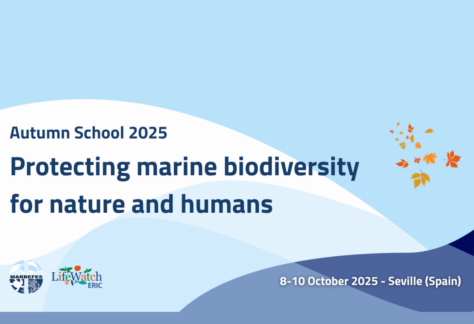
MARBEFES Autumn School 2025
The MARBEFES (MARine Biodiversity and Ecosystem Functioning leading to Ecosystem Services) project aims to evaluate and characterise the links between marine biodiversity, ecosystem functioning, ecosystem services and the resulting societal goods and benefits in coastal communities. The results of these evaluations feed into easy-to-use tools to help practitioners and policy maximise the ecological value and optimise a sustainable socio-economic use of the marine system for current and future generations. Autumn School 2025 The project members will present and examine these tools, for biodiversity and ecosystem assessment and measurement, and ecological, social and economic evaluation, during the Autumn School 2025 “Protecting...
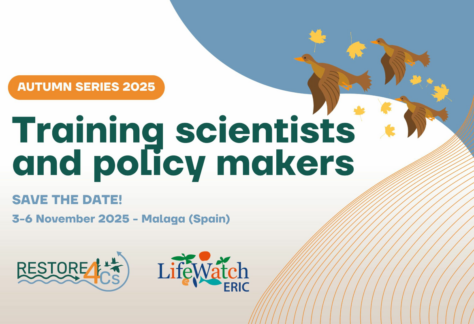
RESTORE4Cs Autumn Series 2025
The RESTORE4Cs (Modelling RESTORation of wEtlands for Carbon pathways, Climate Change mitigation and adaptation, ecosystem services, and biodiversity, Co-benefits) project assesses the role of restoration action on wetlands capacity in terms of climate change mitigation and a wide range of ecosystem services using an integrative socio-ecological system approach. The main output of the project consists of a digital platform that will serve as a Decision Support System (DSS) for stakeholders around wetland restoration for climate change mitigation, biodiversity, and other services. This platform will provide stakeholders and wetland practitioners at all levels with more reliable estimation of cost and benefits...
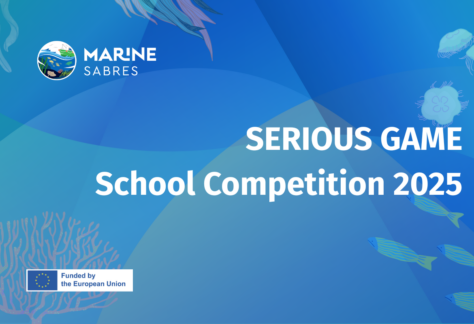
Marine SABRES School Competition 2025
The Marine SABRES project invites secondary school teachers across Europe to take part in the Marine SABRES School Competition 2025, an online learning experience built around a new serious game that brings pupils closer to the science of our ocean. This initiative is designed for teachers of natural and social sciences, English and CLIL, citizenship, and environmental or sustainability education, and supports both lower (10-13) and upper (14-18) secondary students. Only teachers can register and, on the day of the School Competition, they will mentor their students while they play the online serious game. The School Competition will take place...
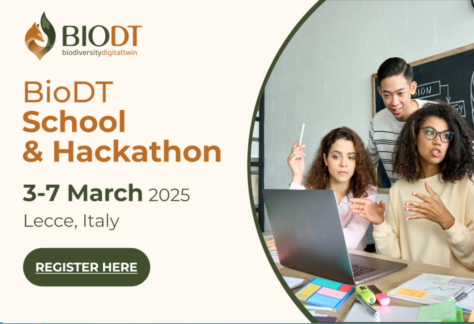
BioDT School and Hackathon
Building Digital Twins : The BioDT Experience The BioDT School and Hackathon will take place from March 3-7, 2025, at the heel of Italian Peninsula – in the city of Lecce, Italy. This unique event is designed for students, early-career researchers, and professionals interested in unlocking skills in digital modelling, and interested in latest innovation practices in biodiversity. Whether you are new to the concept of Digital Twins or looking to deepen your knowledge, this is the perfect opportunity to engage with leading experts and learn how digital twins are developed, especially through the lenses of BioDT use cases. Register for...