Some examples of Applications to Ecological Issues
3. The IFM for area-wide pest management[13]
In Gilioli et al., (2013) a mosaic of different spatial units (patches) infested by a monophagous pest has been considered and the interplay between pest population dynamics, dispersal and area-wide control strategies investigated. A threshold-based management is assumed to be an appropriate control strategy. Therefore, the transition of population abundance from above to below the management threshold, due to either the decline of the local population or to control intervention, is represented as an extinction process. This allows the application of an IFM.
Data from a three years survey of the Pine processionary moth (Traumatocampa pityocampa (Den. and Schiff)) populations dynamics in fragmented forest stands of the National Park of Aspromonte, Calabria, Italy (Figure 12.3) have been analysed.
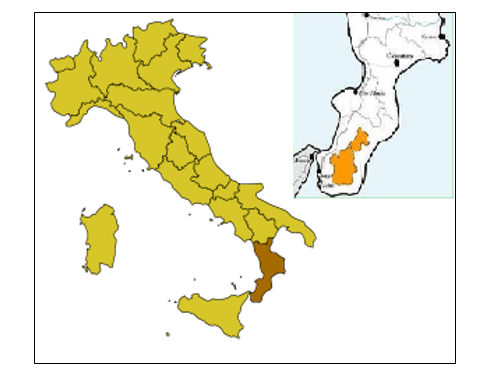
Figure 12.14 – Calabria region in Italy and National Park of Aspromonte in Calabria.
Italia: 
Dettaglio: http://www.corpoforestale.it/flex/images/D.b69b2522d0cd945a94aa/P_N_ASPROMONTE_250.JPG
The metapopulation consists of 32 forest fragments, see Figure 12.4.
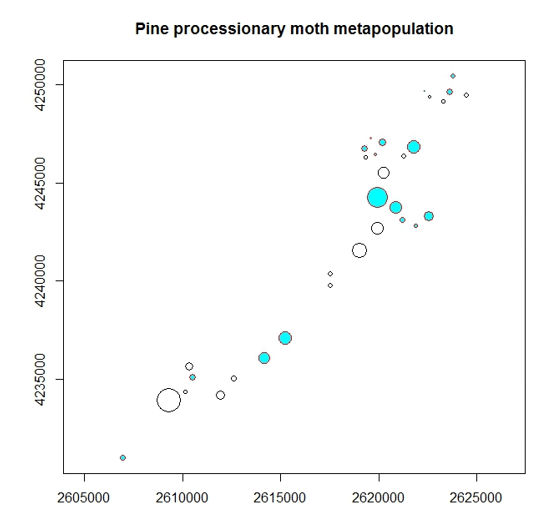
Figure 12.15 – Pine processionary moth metapopulation in Gilioli et al., 2013: first presence/absence vector.
In this study, different management strategies of pest control are defined in terms of spatial and temporal allocation of treatments, regardless of the adopted control technique. The only requirements are that the patch area is the minimum spatial unit of intervention, and control operations target the entire pest populations in a patch. A threshold-based pest management has been considered, meaning that local population abundance is kept under a threshold whatever defined (e.g., action threshold) as a consequence of an effective intervention.
For the spatial allocation, three kinds of strategies are compareda) scattered sites, (b) close sites and, due to the geometry of the PPM metapopulation, (c) in line sites. Examples are in Figure 12.5.
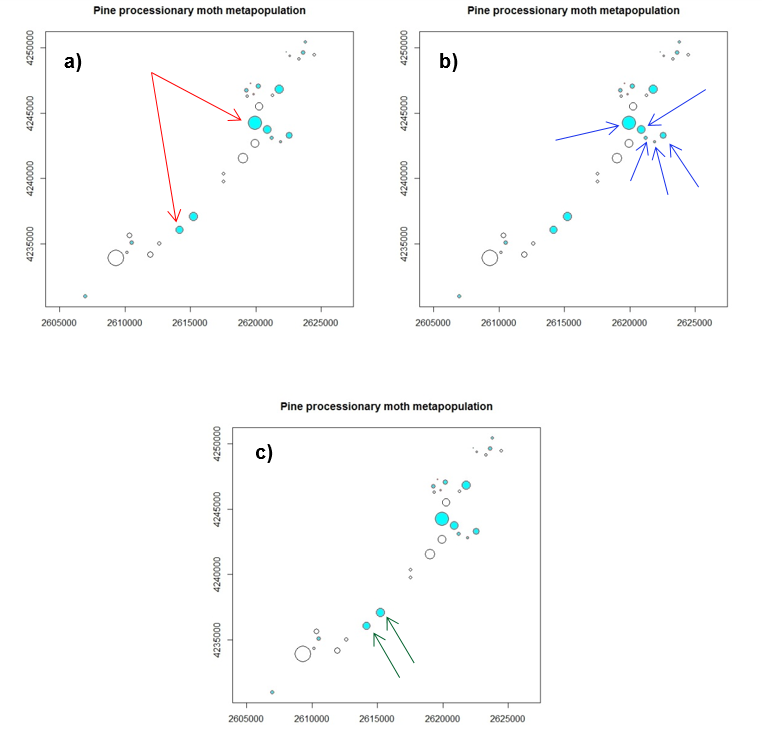
Figure 12.16 – Instances of scattered (a), close (b) and in line (c) patches to be treated (marked by arrows), representing three possible spatial treatment allocations.
In this paper, a time-dependent IFM (without rescue effect) has been fitted to all the considered spatial management strategies. Moreover, the inclusion of time allowed the consideration of different combinations in time of spatial strategies. That is, a short-term horizon has been established (five years after the last collection of data), at each time in-between some strategy has been applied, and the effect of each sequence of treatments has been evaluated at the last year by the Kullback-Leibler divergence. This required the repeated simulation of the metapopulation dynamics for 5 years after the last collection of data, as in Example 7.3 to estimate P(XT = 0) at the evaluation time T (i.e., 5 years after the last collection of data), where XT is the random vector of presence/absence at time T, as in Section 6.1.. At time T, the distance of the predicted metapopulation status from total extinction according to the Kullback-Leibler divergence is
$$-ln[P(X_(T,1)=0,…,X_(T,n)=0 )]$$The best strategy is the one providing the lowest value of such a distance.
After the examination of several management strategies, the authors argue that treating close patches has an higher effect that treating scattered patches, as this seems reduce connectivity. About this issue, however, further deepen insight should be gained yet.