A few hints about the ecological problem and the Incidence Function Model (IMF)
A few hints about the ecological problem and the Incidence Function Model (IFM) - Page 6/6
Spatially explicit metapopulation models are a widely used tool in conservation biology (Vos et al. 2000, Ter Braak & Etienne 2003; Gilioli et al. 2008), while they have received little attention in pest control (Hunter 2002; Gilioli et al. 2013). The apparent lack of interest in applying the IFM and its generalizations to pest is surprising, because it would enable managers to take into account several spatial and habitat features (Gilioli et al. 2013), and express management actions as far as management outcomes in terms of model variables.
Indeed, variations in patches locations could be considered for management (Figure 8b), as well as variations in some patches areas (Figure 8c) and patch occupancies (Figure 8d) for instance.
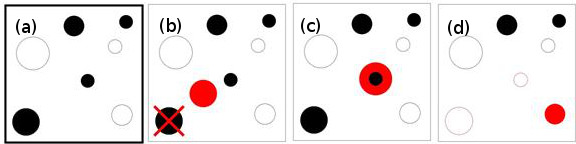
Figure 8 – Instances of management actions represented by changes to model variables, compared to the original metapopulation (a). (b) Variation of a patch location (from the crossed black to the red one); (c) variation of patch area (from black to red); (d) variation of patch occupancy of the red circles/disks.
This is particularly relevant for management. Indeed, in the most recent years it has been pointed out that metapopulation models should be embedded in a decision-making framework to give managers the capability of ranking alternative decisions (Westphal et al., 2003). This means that the objectives of the management should be explicitly and clearly stated in terms of metapopulation model variables (Possingham et al., 2001; Gilioli et al. 2013), to also underpin an efficient allocation of resources.