A few hints about the ecological problem and the Incidence Function Model (IFM) - Page 2/6
In general, the objects for conservation are populations, and predictions as well as ranking of management strategies are based on demographic approaches and viability analyses (Akçakaya & Sjögren-Gulve, 2000; Drechsler & Burgman, 2004). With respect to conservation biology, the main question is whether a given species is likely to persist as a metapopulation in a particular set of habitat patches, and how modifications in the number, quality and connectivity of habitat patches may affect population viability (Hanski, 1999). These aspects are even more important when conservation strategies have to be implemented in areas with intensified agriculture, residential zones or industrial sites, where they could give rise to conflicts of interest among different land users.
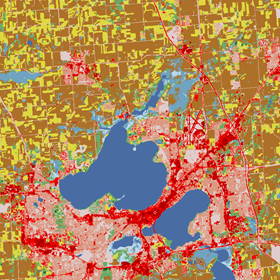
The clear need for an explicit representation of patches in space has demanded the development of different metapopulation models. In this course, Figure 2 or similar pictures will be used to represent a metapopulation as described by a spatially explicit metapopulation model. Unlike Figure 4, such pictures allow us to visualize the differences among patch areas and between-patches distances, for instance, two key elements of the metapopulation spatial structure. Figure 2, however, differs from a third kind of spatial representation, like that in Figure 5, typical of landscape analysis. In this case, the geographical information reaches a higher level of detail, often coming from a spatial analysis by a GIS software.
|
 |
|
|
Figure 5 – Land cover surrounding Madison, WI. Fields are colored yellow and brown, water is colored blue, and urban surfaces are colored red.
|