About this Tutorial
Species Distribution Modeling: aims, theory and applications
In the last decade Species Distribution Modelling (SDM) become a technique widely used in many fields of natural and biological sciences to infer the ecological requirements of species and to predict their geographic distributions (Elith & Leathwick, 2009). Species distribution models can be used to support conservation decision making (Guisan et al., 2013). Forecasting endangered species distribution under climatic change scenario is increasingly used in conservation biology (Muñoz et al., 2013), while forecast the spread of invasive species is receiving a growing interest in invasion biology (Verbruggen et al., 2013). Furthermore, many phylogeographic studies, focusing on the influence of past climatic changes on the observed spatial distribution of genetic diversity, merge information from molecular biology and SDM to infer intra-specific evolutionary patterns (Knowles et al., 2007; Alvarado-Serrano & Knowles, 2014). Species distribution models are also known as ecological niche models (ENM), habitat suitability models and bioclimatic envelope modelling. Many researchers consider these definitions mainly as synonyms and here we will refer to this class of methods as SDM. However, it worth to note that some others researchers pointed on the fact that these terms (particularly SDM and ENM) are not fully interchangeable and their differences are not merely semantic (Townsend Peterson, 2006; Townsend Peterson & Soberón, 2012) but depend of the choice of the set of variables used to predict niche and distribution and to the focus of the study (i.e. niche quantification versus spatial predictions). From a practical point of view, both SDM and ENM are identical: use the same software, largely rely on similar assumptions and in most of the cases share the same set of predictors. The aim of SDMs is to infer the probability of occurrence of a taxon given a set of variables (climate, elevation, soil type, etc.) that are assumed to be related to the distribution and habitat preferences of the taxon under study. The habitat suitability of a give species is then extrapolated on the basis of the conditions observed in known occurrence sites (Fig. 1). The inference of habitat suitability and distribution range of a species might be accomplished by using different algorithms (see below). This wide array of statistical approaches offers flexibility and can address different problems. However, the quality and reliability of SDMs depends always on the quality and appropriateness of the species occurrences and environmental data inputs, the expert opinion and the recognition and treatment of uncertainty in the model outputs.
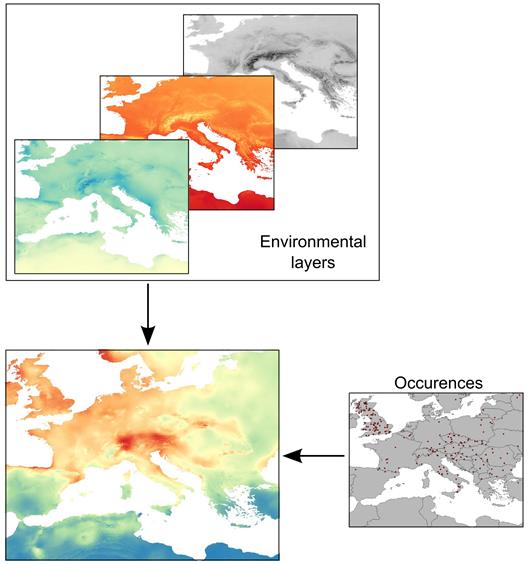
Figure 1: A scheme of Species Distribution Model. Environmental layers (climate, elevation, soil types) combined with known occurrences allow to identify the potential distribution of a species